Does Virtual Reality Have a Place in Modern Social Work?

Virtual reality. The idea of entering an alternative universe or an immersive environment was merely a notion for science-fiction not so long ago. However, advancements in digital technology and production have made virtual reality (VR) not just an actual reality but accessible to the general public. Today an interested party can buy a portable headset for under $400, less than a new series Xbox. In fact, the VR market is expected to reach $22.9 billion by the end of 2020, with 37 million headsets expected to be in use worldwide (Milijic, 2019). With the popularity and availability of VR technology growing at exponential rates, we need to explore areas outside of gaming where this technology can support and advance current practices. What possibilities does VR offer social work?

Researchers have begun to examine just how VR technology can improve our current evidence-based practices. Lindsey Getz discusses some of the ways virtual reality has been researched, as well as possibilities and future advances, in her 2018 Social Work Today article. She describes early research on VR in treating addictions where clients can practice coping skills in a realistic setting without the risks of a real-world situation, as well as the development of an exposure therapy application to treat PTSD. Ms. Getz suggests VR can be an additional tool for therapists to deliver already established evidence-based practices but cautions it is not a replacement for the expertise of a clinician.

            In his October 2020 podcast, Tom Oates interviews two research assistant professors from the University of Utah’s School of Social Work about the development and use of virtual reality to train students and staff in child welfare agencies. The researchers noted, unlike many other professional roles, social work strongly relies on learning on the job to training. Military, pilots, and even Wall Street traders utilize simulation training in conjunction with real-life practice to improve their skills. They emphasize the need to rely on collaboration networks to access resources such as funding. From there development must be based on theory to enhance effectiveness. Tools for implementation included coaching, operationalizing, adapting for best contextual fit, availability, trialability, and post-training support.

Bell et al (2020) recognized the capabilities of VR could be beneficial for both assessment and treatment of mental health issues and conducted a literature review regarding the benefits, applications, and challenges to integrating VR into mental health services. VR has been seen as beneficial since it allows users to control and manipulate the environment and can be individualized to client needs and abilities.

            Persky and Lewis (2019) reviewed the use of VR in behavioral medicine, its impact on patient care, challenges to translating research to practice, and the role of implementation science in facilitating VR use. Given preliminary research in immersive technology for treating some behavioral medicine concerns, the authors wanted to better disseminate information regarding how these technologies could improve client outcomes and ways to introduce VR into clinical settings.

What’s stopping virtual reality becoming a social work reality?

            Keller et al (2017) used social listening to better understand public opinion related to virtual reality in healthcare. The authors recognize the multiple successful uses of VR to treat both medical and physical concerns. They point out that the acceptability of the platform is an important characteristic to consider for successful implementation. Through analyses of unsolicited feedback on Facebook about a news video regarding the use of VR at Cedars-Siani Hospital, it was found that there was generally positive regard for the clinical application of VR by the general public.

So why VR has not yet changed our lives even though it is being used in many areas of research and training? Nicole Garrison (n.d.) identifies five barriers to the more general use of VR. These include the cost of tools to use and develop the technology, the need for more consumer-friendly transportable design, and lack of consumer awareness about the advances VR could make in multiple person-centered industries. Traditionally people were more often exposed to new technology in the workplace. Now things such as AR and VR are more common in our personal lives and will likely be introduced more readily to the workplace by younger technology-infused generations.

Laurell, Sandstrom, Bethold, & Larsson (2019) sought to identify barriers to the uptake of VR particularly related to the technology itself along with cost and trialability. The authors were unable to identify previous attempts at determining why VR had been better diffused or ways to address these barriers. They analyzed social media data related to Oculus and HTC headsets specifically to identify ways users interacted with and discussed the platforms. The functionality of the technology (how fun it was, how easy to use), and the availability of applications (apps) were the primary concerns of users. Cost and trialability were less often mentioned by users, however, they did contribute to the decision to buy. Although technological advances have made VR easier to set up and use there is still an issue with cost. Even more challenging is the lack of evidence and consistent research to support the use of VR in treatment. Additional barriers include lack of inner setting structure to support VR use, lack of training and evidence-based applications, time and resources to support the learning curve, and the fear of technology replacing mental health professional roles (Bell, 2020) as well as the functionality of the technology, ease of use, and the need for more realistic VR scenarios (Keller et al, 2017).

So what will help social work embrace this new tool?

There have been no clear recommendations for overcoming barriers for VR use in treatment. In 2018 Gleg and Levac examined the barriers and facilitators to the use of virtual reality in clinical practice. They wanted to assess what was preventing clinical staff from using VR given the evidence it was a useful tool. They also sought to identify interventions that promoted the adoption of VR by addressing these barriers and make recommendations for future development. A scoping review of journal articles regarding the uses of VR in clinical settings over the past 13 years was completed. To overcome these challenges the following recommendations were made base on principles of implementation science:

  •  Making context-specific assessments in places where VR is being considered as an intervention
  • Training staff in the technology
  •  Including clinicians and game developers in the planning and designing of clinical VR applications
  • Involving stakeholders as early as the development stage
  • Selection, training, and systems intervention drivers play a part in VR adoption according to the article.
  • Clarifying and developing appropriate research methods to meet standards of evidence-based
  • Expanding on theories of behavioral change
  • Improved understanding of organizational readiness in adopting VR

 (Perskey and Lewis, 2019; Gleg and Levac, 2018).

So what’s next? Does virtual reality have a place in the assessment and treatment of those we serve? Can it be a tool that enhances evidence-based practices? Can social work as a profession embrace change and technology? Only time will tell.

References

Bell, I., Nicholas, J., Alvarez-Jimenez, M., Thompson, A., & Valmaggia, L. (2020). Virtual reality  as a clinical tool in mental health research and practice. Dialogues in Clinical Neuroscience, 22(2), 169–177.

Garrison, N. (n.d.). Why haven’t AR And VR changed our lives yet? 5 barriers to adoption.  ARPost. Retrieved October 12, 2020, from https://arpost.co/2019/11/27/ar-and-vr-changed-our-lives-5-barriers-adoption/

Getz, L. (n.d.). A Whole New World—Virtual Reality in Social Work—Social Work Today  Magazine. March/April 2018, 18(2), 6.

Glegg, S. M. N., & Levac, D. E. (2018). Barriers, facilitators and interventions to support virtual reality implementation in rehabilitation: A scoping review. PM & R : The Journal of Injury, Function, and Rehabilitation, 10(11), 1237-1251. 

Keller, M. S., Park, H. J., Cunningham, M. E., Fouladian, J. E., Chen, M., & Spiegel, B. M. R.  (2017). Public perceptions regarding use of virtual reality in health care: A social media content analysis using facebook. Journal of Medical Internet Research, 19(12).

Laurell, C., Sandström, C., Berthold, A., & Larsson, D. (2019). Exploring barriers to adoption of  virtual reality through social media analytics and machine learning – An assessment of technology, network, price and trialability. Journal of Business Research, 100, 469–474.

Milijic, M. (2019, October 15). 29 Virtual Reality Statistics to Know in 2020. Leftronic. 

Oates, T. (n.d.). Transcript_cwig_virtual_reality_next_step_caseworker_training.pdf (No. 43).  Retrieved October 13, 2020, from https://www.childwelfare.gov/pubPDFs/cwig_podcasts/transcript_cwig_virtual_reality_next_step_caseworker_training.pdf

Persky, S., & Lewis, M. A. (2019). Advancing science and practice using immersive virtual reality: What behavioral medicine has to offer. Translational Behavioral Medicine, 9(6), 1040–1046.

The racial bias impact on children in foster care

Disproportionality is described as the proportion of racial minority children in child welfare in relation to their representation in the general population (Kokaliari, Roy, & Taylor, 2019; Hill, 2006). African American, Native American, and Hispanic continue to be overrepresented in the child welfare system (Miller, Cahn, & Orellana, 2012).  There are known disparities in the treatment of these children in comparison to their white counterparts including longer stays in care, increased risk of re-victimization and placement stability, and less frequent placement permanency (Huggins-Hoyt, Briggs, Mowbray, & Allen, 2019). 

Research suggests that race can impact decision-making among medical professionals to make a report as well as subsequent actions of child welfare workers in investigations (Miller et al., 2012). Miller et al. (2012) and Kokaliari et al. (2019) each suggest other areas that additionally impact decision-making, both highlighting lack of trust by families and the impact of poverty on family resources.

In New York State there is a disproportionality of minority children in care.  Minority children make up a much higher percentage of children in care despite their overall percentage of the total population.  (The Annie E. Casey Foundation, 2019; NYS OCFS, 2019).  Families who interact with the child welfare system need to know the factors that contribute to the ongoing issue of disproportionality for entering and remaining in care in order to be better prepared to collaborate with the system. By having an improved understanding parents may better navigate the process, reduce the length of time in care, and therefore reduce the trauma to the family and children.  In addition, it may encourage more people to become foster parents in order to increase both available placements, including racially and culturally similar homes.

This infographic provides statistics regarding the number of racial minority children in foster care in 2018 and as it compares to their representation in the general population as well as frequency of being placed in similar racial/cultural homes to the family of origin. The graphic also illustrates how racial bias impacts minority children in care and makes broad recommendations to improve services.  The graphic concludes with a website that provides data, recommendations and tools benefit children.

References

Hill, R. B. (2006). Synthesis of research on disproportionality in child welfare: An update. Retrieved from Casey-CSSP Alliance for Racial Equity in the Child Welfare System https://www.cssp.org/reform/child-welfare/other-resources/synthesis-of-research-on-disproportionality-robert-hill.pdf.

Huggins-Hoyt, K.Y., Briggs, H.E., Mowbray, O., Allen, J. L. (2019). Privatization, racial disproportionality and disparity in child welfare: Outcomes for foster children of color.  Children and Youth Services Review, 99, 125-131.

Kokaliari, E.D., Roy, A.W., & Taylor, J. (2019). African American perspectives on racial disparity in child removals. Child Abuse & Neglect, 90, 139-148.

Miller, K.M., Cahn, K., & Orellana, E. R. (2012).  Dynamics that contribute to racial disproportionality and disparity: Perspectives from child welfare professionals, community partners, and families. Children and Youth Services Review, 34, 2201-2207.

New York State Office of Children and Family Services (2019). 2018 Monitoring and  Analysis Profiles with Selected Trend Data: 2014-2018. Office of Strategic Planning and Policy Development/Bureau of Research, Evaluation and Performance Analysis. Retrieved from https://ocfs.ny.gov/main/reports/maps/counties/New%20York%20State.pdf [accessed 8 November 2019]

The Annie E. Casey Foundation Child Kids Count Data Center. (n.d.) Population by race in New York.  Retrieved from https://datacenter.kidscount.org/data/tables/103-child-population-by-race?loc=1&loct=2#detailed/2/34/false/37/68,67,12,66,72/423,424 [accessed 29 November 2019]

Trauma 101: The Basics No One Told You and You Didn’t Know to Ask

Fight, Flight, or Freeze (FFF) Responses

The brain is an interesting muscle.  It can do so much and yet we don’t utilize more than ten percent of its capabilities.  It is responsible for all the other muscles and functions in our body, and it is multitasking all the time (consciously and unconsciously).  It has this neat thing called neuroplasticity, meaning despite any damage to some of its parts the muscle can be strengthened and experience some healing.  In trauma this is evident in the fight or flight response, which has been expanded to include freeze and fawn.  You can read more about these responses here, but it is important to understand the basic brain structures in this response system. 

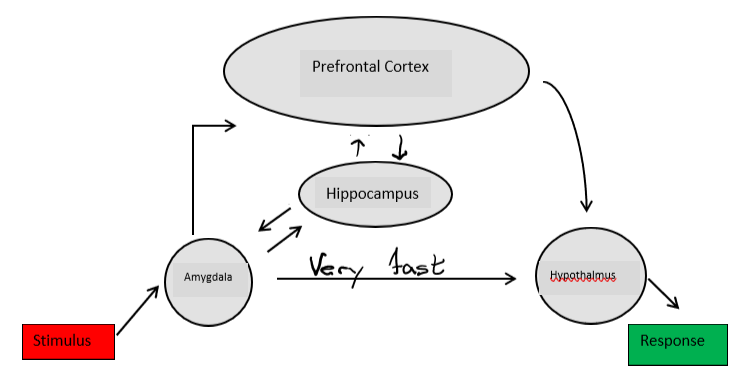
Back in the caveman days we needed to stay alive, so our bodies needed a way to keep us safe without overworking our muscles when it was not necessary.  Imagine a sabretooth tiger slowly coming to the cave opening-it is crouched low to the ground, its head is lower, and ears are back, the mouth is open slightly reveling fangs and there is drool.  Our amygdala senses there is a danger, checks with the hippocampus quickly (which remembers another time when it saw this scene and it was not safe), and quickly tells the hypothalamus to make the body run (flight), grab a weapon and defend itself (fight), or be really still (freeze).  This all happens extremely fast, because if there was too much time to think our ancestors would have been eaten and we would not be here reading this.  This is a survival response.

In order to do any of these effectively the body makes some major changes.  Pupils dilate to see better, goosebumps appear on the skin as hair stands up to better sense the environment, breathing becomes quicker and shallower, and the heart rate increases-that way the muscles have more blood and oxygen to work better.  Other tasks are less important and they stop, like digestion (butterflies in the stomach) and urination.

However, our body cannot remain in this heightened state for too long or it will become overworked, sometimes causing unhealthy physical effects.  The prefrontal cortex is able to talk to the hippocampus and the amygdala to determine when the situation is once again safe and works to return the body to its usual functioning.  In addition, if that “sabretooth tiger” was simply your neighbors’ cat walking by, the hippocampus will find it in its memory, share it with the cortex and the whole system is shut down almost immediately because there is no danger.  This process is much slower than the FFF response.  This all looks something like this: 

Text Box: Hypothalmus

How does trauma impact the FFF Response

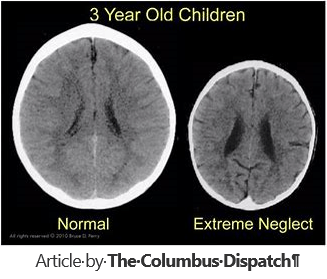
For children who have experienced complex trauma, they never know when or where the abuse may come from.  Therefore, they always operate on the FFF response to a stimulus.  Unfortunately they have learned that they cannot predict who or what is safe so everything starts to become a threat; they do not have the luxury to check with their memory and determine if there is something different this time that may mean they are safe.  Like any muscle that we work out all the time, the FFF response becomes very strong, and the more logical thinking parts of the brain begin to atrophy.  Scientists have seen images of trauma victims’ brains that show the reasoning centers of their brains are much smaller than those without trauma.  At the very core they are thinking differently.  They must always be ready to keep themselves safe for their own survival.

Behaviors indicative of children with complex trauma

So now we know what is happening in the brain.  Many of the kids we are educating or raising are now in safe environments that no longer require the FFF response to always be on.  So how can you tell when the response system is activated, even when it does not need to be?

  • Trembling-increased hormones caused by the FFF response can cause muscles to shake as they are preparing for hard work
  • Hyperventilating-the shallower quicker breath meant to oxygenate the blood faster
  • Complaints of “chest pains” -increased heart rate pumping blood faster to the system
  • Sweating-perspiration increases to keep the body from overheating during the survival response
  • Hypervigilance-always scanning and watching for potential danger, always “in the ready”
  • Tunnel Vision-focus on one stimulus causing distress and unable to shift focus.  This could be on an object, behavior, or topic of conversation.

Providing a supportive environment/Trauma Informed Care

There are many ways to be supportive to a child who needs to learn how to manage their survival response and become better at assessing the people and situations around them.  They need tools that can help delay the automatic survival response long enough to let the thinking parts of the brain exercise and grow stronger, helping them make better decisions.    The great thing is, the more they work out the brain, the stronger the atrophied parts can become, and they will heal.  Sensory Modulation is a great tool that helps children learn ways to retrain their survival response.

  • Sight-pictures of pets/family/friends they find pleasant and safe, Defocus books where they look for patterns, Seek and find books where they have to locate specific objects
  • Sound-music and sounds the child finds pleasant.  This may take some adult supervision for appropriateness.  Playing or resuming playing a musical instrument.  A loved one’s voice pre-recorded.
  • Smell (*warning: smell is the fastest way to trigger a positive or negative reaction, smell works directly on the amygdala)-favorite perfume of a loved one, favorite food, favorite dessert
  • Taste-fireballs, favorite food/drink, salty things, sour things
  • Vestibular rocking, swinging
  • Tactile-manicures, head rubbing/scratching, soft or hard items, favorite blanket or material,

This is a basic outline and understanding of how trauma impacts the brain of a child and how we can support resiliency.  It is important with any of these tools to offer choice whenever possible.  This can be empowering to a child who has felt their life was completely beyond their control, including their safety.  Just because you like something does not mean they have to like the same things. Help them identify what they find helpful.  These can change from day to day.  Once thy find these things take the time to show interest and learn about them.  That way, when the brain is thinking in pure survival mode, the child can rely on you to provide those coping tools.  And don’t forget the power of play. Play is where children work out their struggles and can find/practice good coping skills.

Remember, it’s not “What’s wrong with you?” but rather “What happened to you?

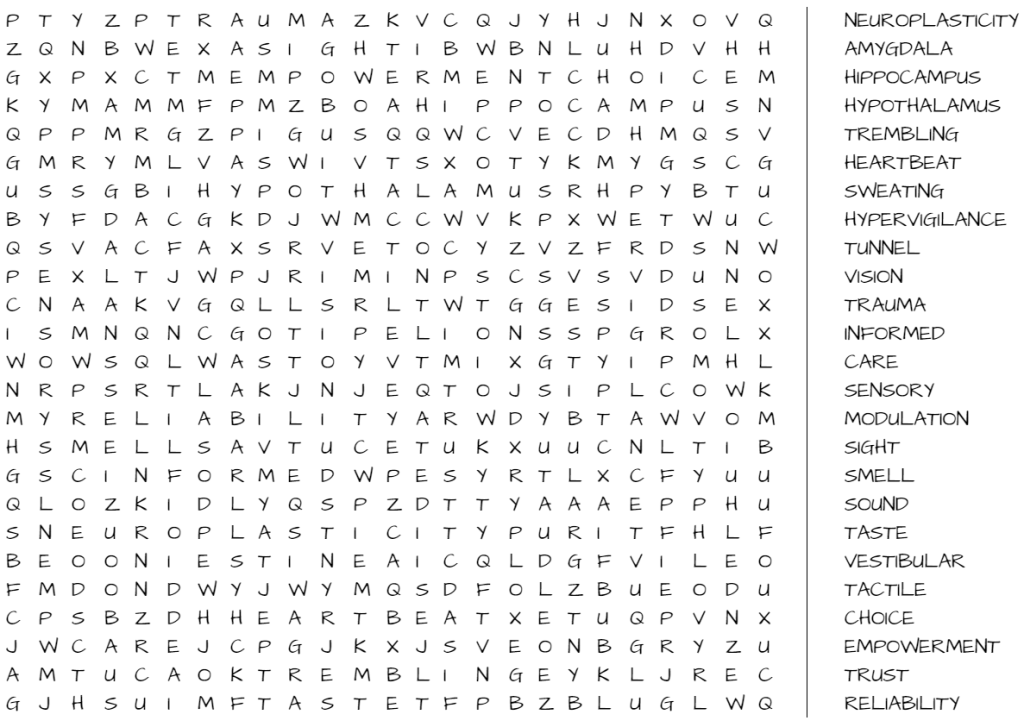
Now, have a little fun and find these important words in the word search below:

How Trauma can Lead to Positive Outcomes, Post Traumatic Growth

We have all heard of Post-Traumatic Stress Disorder (PTSD) and how challenging it can be in a person’s life.  As a society, we have become more concerned with the types of abuse faced by children and how it can potentially negatively impact the rest of their life.  We talk about PTSD in relation to abuse, natural disasters, war, and any number of other events that overwhelm a person’s ability to cope.  However, PTSD just came into formal diagnosis in 1980, with the DSM-3, but its existence is much older than that.  Professionals first began to examine post-traumatic stress when they noticed a set of similar symptoms that interfered in the daily lives of young men returning from the Vietnam War, but its existence is still older than that.  Traumatic experiences have been part of the human experience as long as there have been humans on the planet, and from those experiences, our world has grown into what it is today.  In other words, those events that we think of as life-ruining may be better described as life-altering as the experiences may negatively and positively change a person.

Post-traumatic growth can be seen as a positive change in a person as a result of trauma that supports the return to an improved level of functioning.

For parents, foster parents, educators, and caregivers dealing with the challenging after-effects of trauma on a child it may difficult to imagine there may be something good that can come out of all these struggles.  Psychologists refer to this positive outcome as post-traumatic growth (PTG) and it has been growing as an area of research in the past 10 years.  Post-traumatic growth is defined as positive psychological change experienced as a result of adversity and other challenges in order to rise to a higher level of functioning.  It occurs when an event challenges a person’s core beliefs and causes significant struggles that ultimately lead the person to gain a deeper understanding and ultimately grow from their experiences.  This does not deter from the experience of trauma but offers a person a different perspective to work through it.  For more in-depth information you can read here.

There are 5 areas by which PTG are defined:

  1. Appreciation of life
  2. Relationship with others
  3. New possibilities in life
  4. Personal strength
  5. Spiritual change

Examples of PTG

One of the most notable recent examples of post-traumatic growth came in the aftermath of the Parkland school shootings.  These can easily be seen as an even that rocked core beliefs (school is a safe place), caused psychological distress (grief, confusion), and ultimately lead to growth and advocacy (March for Our Lives).  ABC News did a story on how some victims demonstrated the above areas of growth, which was again emphasized in a post from Shrink Tank.

There are other notable examples of trauma turned advocacy and growth.  When a mother gets the call that her 13-year-old child has died because a drunk driver with a long history of DWI hit her, she begins a campaign to prevent other parents from experiencing her pain.  When the core belief that the legal system keeps us safe is shattered and causes extreme emotional distress of anger, grief, and confusion the result is the creation of Mothers Against Drunk Driving (MADD).

Another example is when a 6-year-old child shopping with his mother, ends up missing from the Atari section and later his decapitated head is found but not the rest of his body with no killer ever convicted a father work to improve how the cases of missing children are managed from the micro to the macro level.  When the core belief that the world is a safe place results in pain, grief, and frustration the result is the Center for Missing and Exploited Children.

PTG as Resiliency and Hope

It is important to note that no one, not even a trauma-based therapist, can force post-traumatic growth in a child.  What they, and caregivers, can do is foster areas that contribute to PTG and support a child’s efforts to grow. As a caregiver or important person in a child’s life, there are several things you can do to encourage post-traumatic growth.

  • Be consistent and involved enhances an appreciation for life and relationships with others.
    • This does not just mean attending scout meetings or going to parent-teacher conferences.  It means putting down your phone and being attentive to whatever nonsensical story it is really important they tell you right now.  Not just listen but sit down, look them in the eye, and really hear they have to say.  Ask questions, keep the conversation going, remember what they say for later.  Validate their feelings even when it doesn’t make sense to you.  It doesn’t have to, it’s not your feelings. 
    • It also means taking an interest in their interests, even if it doesn’t interest you.  Take time to ask about it.  Pursue information about it on your time and surprise them with what you know.  How better to show someone you care than taking the time to find out about what they like.  And don’t just learn about it, try it.  It’s okay to let that teenage boy humiliate you in a game of Rocket League if you took the time to learn some of the terms and spent the time playing with them. 
  • Introducing new things and give to the community can build on new life-possibilities and strength
    • One of the biggest things I see working with young children in an inpatient setting is their wonderment at new things.  Doing things like going to the zoo, visiting a park or walking in the woods, playing board games together, or riding bikes have been brand new experiences to more than half of them.  Group activities like sports and clubs are also new experiences, and when they discover something they love and are good at, a whole new world of possibilities opens up for them.  They may need some gentle support to get out there, but getting out there can be a good place to be.
    • Another activity that can be helpful is the act giving back.  It is inherent in human nature to want to contribute in some way, and children are no different.  From collecting pet items and delivering them to the SPCA to becoming peer advocates youth find a way to take their negative experiences and help others.  They don’t need to start a foundation or solve world hunger, but they know what it feels like to have a need that’s not meeting met.  Sometimes the best way to heal that need for yourself is to do it for others.

Post-traumatic stress is a newer concept in mental health and even newer in relating it to children.  What studies thus far have shown is not everyone experiences PTG, but there are ways to support a traumatized child that may foster it.  And we have seen real examples.  What’s amazing is once the growth begins there is no way to know just how far it will go.

Multi-Disciplinary Approach to Complex Trauma: Does it really take a village?

For a long time, the concept of “trauma” did not exist.  What happened at home was to stay at home, and if bad things happened you were supposed to “get over it” and “move on”.  It wasn’t until the 1970’s that the term “post-traumatic stress” became a common term-primarily related to symptoms experienced by returning Vietnam Veterans.  It wasn’t until the third edition of the Diagnostic and Statistical Manual of Mental Disorders (DSM-III) in 1980 when trauma was officially recognized by the American Psychiatric Association as a diagnose (PTSD).  Over the next forty years the PTSD diagnosis has undergone a variety of changes as a result of ongoing research and new technology.  We are now more aware of the variety of traumatic experiences and the life-changing effects they have on individuals.  More specifically, the concept of complex childhood trauma has been shown to impact someone from the DNA to their life-expectancy.  Although the call to include complex trauma as a stand-alone diagnosis in the DSM-V (2013) was unsuccessful many of its features have now been incorporated into the current PTSD diagnosis.  This better, more comprehensive understanding of trauma would not have been possible without the hard work of many disciplines who have studied trauma and the brain.  In turn, it takes multiple disciplines to also successfully treat it.

Neuroscience/Biology

Using MRI in children experiencing complex trauma, as well as adult survivors of childhood abuse, it has become clear these experiences cause lifelong changes in several important brain structures.  There are proven effects on working memory, white and grey matter of the prefrontal cortex, the corpus collosum, hippocampus, and brain volume (De Bellis & Zisk, 2014).  These changes impact a person’s ability to organize their thinking, process information, and make decisions.  And these changes are only the beginning.  Changes are also occurring at the DNA and hormonal levels, exacerbating the biological effects and having significant impact on the overall health and wellness of trauma survivors. This information is crucial in understanding trauma as more than a memory or experience, but helped bring trauma into light as a whole health issue. 

Here’s another way to look at it.  A child is in a car accident and suffers an injury to the brain.  After the accident the child has difficulty remembering things and struggles more at school.  Aware of the injury and the change in the child’s abilities due to the known physical injury, teachers and parents may alter their expectations and provide supports.  They may not expect that child to maintain high honor roll grades and may celebrate their success if they do.  The same is true of the brain that it is affected by abuse.  We need to understand it is an injury to the organic brain requiring appropriate expectations, support, and praise for success.

Education

With more information available about the impact of trauma on an individual, school systems are beginning to look at traditional structures and policies as they relate to trauma and student success.  For some districts this is an active process with trauma-informed principles being instituted on every level.  For other districts struggling with meeting basic educational needs of their students due to budget cuts and low attendance, to name a few, instilling trauma informed principles is more difficult to implement.  With trauma comes anxiety, hypervigilance, behavioral problems, and inattention that are often are addressed through disciplinary measures and reflected in poor grades. For children who are already being victimized and have an enormous sense of self-shame these consequences push them away from, rather than foster, a potential resiliency component.  Schools run the risk of increasing the Pipeline to Prison phenomenon of many schools.

The Education Law Center in Pennsylvania released a comprehensive article for educators explaining trauma as it impacts student learning and offering numerous recommendations and best-practices for supporting the academic success of trauma victims. These can be helpful for both educators and parents advocating for their children in academic settings.  Here are just a few of their recommendations:

Recommendations for Classroom Learning

  • Specific strategies such as including discovering and building on the student’s individual interests and competencies; maintaining predictable routines and expectations; maintaining expectations for the student that are consistent with those of his/her peers; and providing positive behavioral supports.
  • Language-based teaching approaches can help students process information and alleviate their fears. Students who have experienced trauma often pay more attention to nonverbal cues than verbal communication, so using multiple forms of communicating can be helpful
  • School evaluations, including psychological, speech and language, functional behavioral, and occupational therapy evaluations, should assess the role of trauma and identify needed supports.

Recommendations at the Policy Level

  • School discipline policies are trauma-informed when they balance accountability with an understanding of traumatic behavior
  • Teach students the school and classroom rules while reinforcing that school is not a violent place and abusive discipline is not allowed at school
  • Minimize disruptions to education with an emphasis on positive behavioral supports and behavioral intervention plans; · Respect confidentiality while using open communication and relationship-building with families
  • Ensure ongoing monitoring of new policies, practices and training.

Occupational Therapy (OT)

The role of OT is to enhance the physical and mental health of individuals by focusing on education, play, social activities, and activities of daily living.  They use discipline specific tools to identify and assess factors that may be impacting full participation in any of the above areas.  When it comes to trauma, the American Occupational Therapy Association, Inc (AOTA) states “Occupational therapy practitioners can serve an important role in addressing trauma at the universal, targeted, or intensive levels of intervention. They are invaluable members of the mental health team because of their knowledge of the cognitive, social and emotional, and sensory components of activity and its impact on behavior (AOTA, 2015).”  When it comes to working with children, occupational therapists with training in trauma and sensory-based interventions are qualified to provide sensorimotor arousal regulation, teach mindfulness strategies to reduce stress and increase coping skills, provide environments and opportunities intentionally designed to increase a sense of mastery, connection, and resiliency, and provide opportunities to facilitate the development of likes, interests, and motivators.  OT’s will often provide services at home, school, hospital, and in the community as part of multidisciplinary teams because of their knowledge of the cognitive, social and emotional, and sensory components of behavior (AOTA, 2015).

For further information on the role of occupational therapists in helping children with complex trauma refer to the complete document published by the AOTA by clicking the image below.

So who else is in the village………

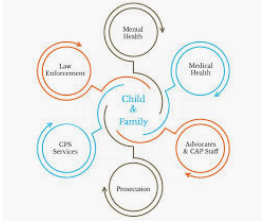
Many different disciplines are looking at the impact of trauma and trauma informed care.  It is being implemented in many aspects of children’s daily life and will hopefully encourage better outcomes for adult survivors of childhood complex trauma.  These are just a few of the disciplines asking the questions and making an impact, and certainly not a comprehensive list of people looking at trauma. What we do know is that all these professionals and viewpoints are necessary to develop the full picture of trauma and resiliency.  It really does take a village to raise a child.

Peer Based Support Services for Trauma Survivors

What is Peer Based Support?

Peer support workers are typically individuals who are successfully engaged in the recovery process who can help others who have or are experiencing similar situations.  Often victims of trauma feel shamed and isolated from others.  They may be working with a mental health professional to address their trauma-related symptoms and still feel alone.  Peer based support can reach beyond the boundaries of treatment by allowing victims to realize that they are not alone, and that there is something better.  Peer Support specialists can provide resources, skill-building, advocacy, and lead recovery groups.  Typically, peer support providers will undergo some training in best practices prior to providing services in this role.  Training may include person-centered and trauma-informed principles, professional boundaries and confidentiality, or creating safe-spaces.  SAMSHA provides guidance for individuals and programs looking to provide peer support services to ensure best practices in services.

Opportunities for Peer Based Support

Peer Based support can be invaluable for reaching out and connecting to survivors of trauma. Abuse brings feelings of shame, self-depreciation, and embarrassment.  Finding out you are not alone and having someone across the table who “gets it” can make a victim feel both supported and safe.

The hope is through their shared experiences peer specialists can help others build on their strengths, empower recovery, foster hope, and support healing (SAMHSA).  Peer specialist will sometimes talk about how being in this role has brought a new level to their own healing while helping others heal as well.  Brenda Lewis is a Peer Specialist with PTSD who talks about her experiences growing up and now provides support and assists childhood victims of abuse connect to necessary resources.

Peer Based Support is as important for children as for adults.  There is growing research and literature that continues to support the use of peers in the treatment team for better outcomes as well as part of organizations in policy and practice development.  The New York State Office of Mental Health requires the hiring and involvement of peer specialists in children and adult programs.  In addition, with the restructuring of community services for children (Child and Family Treatment Support Services-CFTSS) peer and family support services was the fourth service to be made available, ahead of crisis response and respite care. 

Challenges to Peer Based Support

Although mentors and peer support persons can be found for a variety of mental health disorders, complex childhood trauma may be a more difficult area to access this type of support.  As mentioned earlier, abuse (particularly sexual abuse) brings with it a unique set of feelings as it is more than a disease of the brain but a series of violent acts that happened to a person.  In this way, it may be the most difficult diagnosis to speak out about while also being crucial for helping others.

Therapeutic groups can benefit complex trauma survivors as we;;. However, it is important to carefully screen participants for a group that matches where they are in treatment.  Equally important is the selection of peer group moderators.  It is important for facilitators be secure in their own recovery, which includes knowing and managing their triggers and trauma reactions. 

In addition, peer specialists continue to face struggles in being accepted as part of the treatment community.  At times, the peer providers find themselves being discriminated against and left out of important discussions.  This seems counter-intuitive when developing policies and practices that affect individuals without having the voice of those individuals.

Resources for Peer Support

The National Center for Trauma Informed Care (SAMHSA/Center for Mental Health Services) issued a guidebook for engaging women in peer-based support for complex trauma in April 2012.  It contains thirteen chapters on a variety of topics including the principles of trauma, peer-based-support, cultural considerations, structuring support services, and self-care.  In addition, it provides print and electronic resources that can be used to supplement the group proves.  To access the guidebook, click the image below:

Engaging Women in Trauma-Informed Peer Support: A Guidebook

The National Federation of Families for Children’s Mental Health (NFMCMH) is a family-run organization with over 120 chapters.  The NFFCMH includes many resources and supports for families, including numerous resources for peer and family support.  Click on the icon below to access their library.

Unfortunately, the greatest challenge to peer support services may be locating them.  In trying to find a resource to complete this post that would help people link with providers a variety of search terms failed to yield some type of service locator.  I think the point is there needs to be more work done in this area, from funding the development of peer support programs (particularly PTSD) to actively engaging with the community and organizations.  Stay tuned as I will add more resources as I am able to locate them.

References

Blue Know Foundation https://www.blueknot.org.au/Workers-Practitioners/For-Health-Professionals/Resources-for-Health-Professionals/Complex-trauma-treatment

SAMHSA https://www.samhsa.gov/brss-tacs/recovery-support-tools/peers

Caregiver Resources for Children with Trauma

There a lot of resources about trauma and complex trauma, including how it impacts children and how to treat it.  For those charged with caring for and supporting youth who have been traumatized, these effects can create a myriad of questions and barriers.  Parents and caregivers may find themselves asking things like “Why won’t he listen to me?”, “We’ve talked about this a thousand times, why hasn’t it changed?”, or “Why is she getting so upset over something so small?”.  To answer these questions you must first understand hw trauma changed the basic wiring of a child. Here a few resources parents and educators may find helpful in beginning to learn about these very complex issues.

The NCTSN offers a wide variety of educational material around trauma and children.  It includes a section specifically for parents and caregivers that gives helpful information regarding traumatic stress, age-related effects, and even helpful books and videos that can be shared with children.

The Child Mind Institute offers a variety of easy access to tools for families as well as educators, and provides several trauma response guides in nine languages outside of English including, but not limited to, Spanish, French, Arabic, and Chinese.

The National Childhood Stress Trauma Initiative was created between SAMSHA and NCTSN to raise awareness about the impact of trauma on children including related behavioral health concerns.  This site offers several infographics that explain trauma and its effects in a quick and easy manner to understand and digest.

So how does one go about creating a list such as this?  It is important to remember that the web has grown exponentially since its birth.  And why was it born? To allow people to actively engage with and participate in the sharing of information and knowledge in way that books and magazines do not allow.  The internet was started for, and continues to be, a way for people to collaborate across distances in order to work together for some purpose. 

With all these people being able to add to, subtract from, and actively manipulate this system of information sharing it is no surprise that not all information is useful or accurate.  When looking at resources you find on the internet it is important to not just accept anything as fact just because it was published on the internet.  The truth is anyone can post anything, unlike books and journals that are scrutinized by editors and peers, so not all information is good information.  Georgetown University Library provides a condensed and quick list of questions you can use when evaluating a resource.  The general themes are summed up here.

Author

First and foremost, if you cannot identify an author or creator for an article or webpage you should proceed with extreme caution.  If the author is identified, is there a link to a homepage or “About Me” section?  What type of information is on that page about the author(s) credentials, experience, or connections to reputable organizations?

Purpose

Sometimes articles that look informational and/or scholarly turn out to be an attempt to sell a product or persuade the reader to a particular viewpoint.  When reading the material try and determine who the author’s intended audience is-for example are they focusing on experts and researchers or providing important information to the general public?

Objectivity

While examining the intended audience of an article or webpage the reader should begin to form some assumptions on how objective the author is in presenting the material.  If the author, in their personal information, is affiliated with an organization is there a sense of bias in their presentation?  Sometimes biases and opinions can be stated to sound like facts, so it is important to always read with a questioning attitude.  Often if something sounds too good to be true, it probably is!

Accuracy & Credibility

One way to check for objectivity is to check the stated facts.  Can similar information be found elsewhere on other sites and by other authors?  Even if it is presented slightly differently, the core information should be the same.  Does the author use quotations and does the author cite where they found the information?  This could be done by either including the name and author of the work they are quoting or providing a link directly to the resource.  Clicking on these links can be important to verify it is a legitimate resource and if those links still exist, and therefore if the page is regularly maintained.

Timeliness

When looking at a webpage it would be helpful to start by checking when it was created and when was the last time it was updated.  New research is always being completed and information is always being added, so it is important to try and stick with the latest information.  It can be confusing and difficult to keep track of a there can be conflicting information, For example, how many time eggs have gone from being good and then bad and then good again?

In using all of these tools together you can begin to make a general assumption about what is safe and accurate.

Good luck and happy web reading!

When did we go from trying to program a VCR to using smart phones to make mental health diagnosis?

Remember when VCR’s came out and you could record a show to watch later?  It was amazing to think we never again had to miss our favorite shows because we had to go to school or use the bathroom!  And remember how we would roll our eyes at our parents because they were old and didn’t get it just because they needed help programming the VCR?

From young children through young adulthood, the youth of today are growing up in a culture of technology.  The innovations they currently use daily and the ones they will be part of developing almost seem like fantasy  in comparison to the invention of the VCR.  It is safe to say technology is here to stay, and if we are to stay relevant as clinicians, teachers, and care givers we need to not only use it but embrace it if we have any chance of connecting to the younger generations and remaining relevant.

Some people question the large impact technology has on the interpersonal skills of the younger generation and feel they should use it less rather than older generations learning to use it more.  That would be fine if technology was simply a tool for entertainment or socializing. Instead technology is what makes the world go around and without staying on top of the latest trends and tools, older generations could find themselves at a disadvantage in the workplace, possibly losing out job opportunities to younger more tech savvy employees.  Further, without closely studying how companies use technology to make decisions you may find yourself the victim of big data.

What is “big data” do you ask?  Big data is the thousands of pieces of information that are being collected daily and used to make decisions from what product are offered, what ads you see online, and even what results populate to your google search.

Pretty scary right?  It can be and yet for every Yin there is a Yang.  In social work, particularly in mental health, big data can and is being used to advance research by creating bigger data pools across several regions and subsets, making the results potentially more generalizable and useful.  Nicola Davies, PhD, wrote an article in 2016 discussing the availability of large data sets that can be quickly and easily compared through statistical analysis and how they are being used to help with suicide prevention  in terms of predicting suicidal behavior.  To go further, in 2017 Psychology Today published an article, “Will Big Data Save Psychiatry”, wherein Paul Raeburn discusses the potential impact on proper Schizophrenia diagnosis for clients.  Researchers were able to use big data to diagnosis Schizophrenia with a less than 10% margin of error.  Given the difficulties in accurately diagnosing psychosis, and the potential impact on clients when inaccurate diagnosis are made either way, this could be game-changing for mental health.

A screenshot of a cell phone

Description automatically generated

So how does a computer do this?  How does it take large amounts of big data and use it to make diagnosis and assessments?  In two words-artificial intelligence.  Or in simpler terms, these machines learn.  They take in the data they are provided, apply it to the framework they were programmed with, and use this information to make educated predictions or decisions.  Think about it.  Isn’t that how we as humans make decisions? We take the information we are given, compare it to what we already know, and decide based on these two points of data.  In humans that is intelligence, for computers it’s artificial intelligence.  That phrase is scary to some-like the characters in sci-fi movies of old are coming to life.  Yet if you were one of those people who needed an accurate diagnosis for the best possible treatment in order to live your most fulfilling life, wouldn’t you want providers to have the tools to get it right?

Artificial intelligence is being used in the area of trauma as well.  PTSD is most often diagnosed through clinical interview or self-report, both means prone to bias on behalf of the clinician and the client.  Working with Veterans, researchers were able to identify 18 of 40,000 unique biophysical features of speech that could predict with 89% accuracy a diagnosis of PTSD.  Not only is this helpful with proper identification of trauma symptoms, it can be particularly helpful in Telemedicine where in depth interviews over time are not possible for people who live in outlying areas and do not have the available resources to access mental health providers and treatment. 

See the source image

As amazing as all of this is, artificial intelligence and big data do not come without their challenges.  Larger amounts of client data can also skew outcomes, and patient confidentiality needs to be respected at all costs.  Researchers looking at these resources need to ensure their technology and protocols are keeping with the rights of privacy and autonomy for clients.  Even more important is the objectiveness of those programming the computers making the decisions.  Unfortunately it is possible that human bias can be part of the programmed algorithms through what data is fed into the system, what pieces of information the computer is asked to look at, and how much weight is given to some data points such as socioeconomic status, race, age, and sex.  So even though supporters of increased technology boast computer generated data is better as it is more objective than human nature, it is important to remember algorithms can be as biased as its programmers. 

Even with these challenges, however, two things are evident.  First big data and artificial intelligence are here to stay and will only be utilized more and more over time.  Second, these tools have potential to open new doors and new information that can enhance the quality of people’s lives exponentially.  If we as social workers continue to have a louder and more involved voice in the development of these tools future generations may only dream about some of the mental health struggles that our clients face today.  The possibilities are endless……..

5 Myths about Trauma You Always Wondered About………………

Most people have experienced a situation that feels out of their control.  They see the car coming but there is nothing they can do to get out of the way.  The company is going out of business and there is little work in their field.  A loved one gets diagnosed with a potentially life-threatening illness.  As humans we often feel helpless when the circumstances outweigh our resources.  The good news is most people manage to cope with the situation and can move on with their lives with minimal impact.  As adults we have hopefully learned some skills and developed some networks that protect us from the long-term effects of trauma.

What happens when the person experiencing the trauma is five years old?  What if the situation that is beyond their control is being physically abused several times a week?  What if the perpetrator is one of those people who should be protecting them, like a parent?  No one would expect a child to have the resources or ability to manage a situation like this, and there is where complex trauma is born.

NAMI (National Alliance of Mental Illness) reported 50% of youth between 6-17 years of age received mental health treatment in 2018.  Further, nearly 9 million adults were diagnosed with Post Traumatic Stress Disorder in 2016.  Add on the fact that suicide is the second leading cause of death for people ages 10-34 you begin to realize the problem of trauma is larger than you may have believed.  And yet, the world is still wrought with inaccurate beliefs about adolescents with mental illness and PTSD.

MYTH 1: They are only acting that way to get attention

Image result for aggressive child

There is a common misconception that when children act out, they are seeking attention.  However, what we know is all behavior serves a purpose.  Sometimes what looks like inappropriate behavior is actually a survival tool that helped someone manage a difficult situation. Now that they are out of the situation that behavior is no longer needed, yet they engaged in it for so long to get their needs met that it has become as natural as blinking their eyes.  Aggression, for example, may be a child’s learned behavior to keep people away from them as people are not safe in their eyes.

MYTH 2: It happened so long ago they should be able to forget about it.

Unfortunately, as more research is done in the area of childhood complex trauma, we are learning that trauma is more than a memory.  It is not simply events that happened in someone’s life that they may or may not remember.  Early complex trauma affects individuals biologically, most obviously in the structure and size of their brains.  Childhood victims become adult survivors with smaller brain structures, such as the hippocampus and frontal lobe, as well as super powered structures including the amygdala-the driving force of the fight, flight, or freeze response.  In addition, their brains have been found to be physically smaller.  Newer research is showing trauma even has the power to cause genetic mutations that can transmit a parent’s trauma to their child through DNA.

Image result for brain scans of complex trauma

MYTH 3: Trauma and PTSD are only mental health disorders

Thanks to Dr. Felleti and the ACE’s study we have learned that trauma has a major impact on the overall health and life span of a person.  Adults and children with a history of complex trauma are often treated for chronic, potentially life-threatening diseases that are preventable and a direct result of trying to cope with their overwhelming experiences.  Not only do adults with trauma histories die approximately 20 years earlier from preventable disease, this also impacts the health care system as whole including the cost of services, health insurance, and life insurance premiums.  Below is a video of Nadine Burke Harris, MD, giving a TedTalk on her experience with trauma from the medical perspective.

MYTH 4: PTSD is a life-long struggle and cannot be effectively treated

There are several options for treating PTSD from traditional psychotherapies to medications.  One of the most well-known treatments is Trauma Focused Cognitive Behavioral Therapy (TF-CBT) where clients receive psychoeducation about trauma, develop coping skills, and use these to process their “trauma narrative”.  Other evidence-based practices include EMDR (Francine Shapiro, PhD), Progressive Counting (Ricky Greenwald, PhD), and Trauma Based Yoga (Bessel van der Kolk, MD).  Newer research is finding exposure therapy, including the use of Virtual Reality as part of treatment, is also helpful.  There are also some medications that help manage symptoms of PTSD such as Prazosin, Zoloft, and Paxil-all of which are approved for the treatment of PTSD.  Treatment, however, does not erase the trauma but rather allows the person to live the best life they can with their trauma.

MYTH 5: Everyone reacts to trauma the same way

One of the side effects of the DSM V (Diagnostic and Statistical Manual Version 5) is the belief diagnoses are simply check off lists of symptoms, and that the symptoms listed in the manual are the only way in which the disorder manifests.  That could not be further from the truth.  There are people diagnosed with depression who do not sleep all day in a dark room, refusing to get up or shower-they go to work and do what they must at great personal strain, or in children who look irritable or angry.  The same holds true for trauma.  No two people experience trauma the same way so no two people will experience traumatic grief in the same way either.  If one looks at the criteria for a diagnosis of PTSD they will find there are multiple criterion with multiple symptoms in each, making PTSD a personal experience. 

Image result for DSM V

What is quite clear is complex trauma has detrimental effects on all aspects of a person’s life and death and is simply not something that can be ignored.  Trauma, and trauma related disorders, are treatable and people can live meaningful healthy lives.  It is up to the lucky ones, those who have not endured the terrible experiences of ongoing physical, sexual, and emotional abuse and neglect to reach out and support our children and young adults.  They are the next generation and they deserve as much happiness as anyone.

Don’t believe me, watch this video of teens and young adults speak of their personal experiences:

Will technology enhance or destroy the therapeutic process as we know it?

Trauma and its affect on individuals, families, and communities has become a focus of many studies including the development of treatments to improve outcomes for victims.  Yet so many people continue to struggle with symptoms related to their trauma experience and suicide rates remain high among children and adolescents.  What is going on?  How is it with all this knowledge our children and young adults continue to suffer?  What if we held the answers in our hand? Literally.

According to an article by Ruzek & Yeager (2017) roughly 40% of the world population currently as access to the internet while mobile contracts and smartphone use is rapidly increasing.  As technology continues to grow and more people have access to texting and mobile apps there just may be a vast field of possibilities to reach more survivors and enhance ongoing treatments.  For a brief review of current technologies you can read the Ruzek & Yeager article here: https://www.ncbi.nlm.nih.gov/pmc/articles/PMC5719483/

There are countless numbers of apps geared towards teenagers, however there are very few that focus specifically on trauma.  PTSD Coach is the most commonly used app and was designed initially by the Veterans’ Association for soldiers with trauma-based symptoms.  This app provides a variety of interventions from assessment, to psychoeducation, as well as coping strategies, guidance for seeking therapy, and crisis response options. 

PTSD Coach is a great start in technology-based outreach and intervention.  However, it should not be used in place of support of mental health professionals when symptoms are interfering with activities of daily living.  In addition, it may be more involved and require a greater digital literacy that may leave some users frustrated.  On the flip side, PTSD Coach and its partner app, PTSD Family Coach, offer a starting place for the use of technology in treating trauma and supporting survivors.

Unfortunately, although there are a few apps like PTSD Coach that can aide in diagnosis and treatment of post-traumatic stress there appears to be a lack of focus on integrating technology into clinical treatment as well as testing the validity of these applications.  One area of technology that is beginning to be explored is the use of virtual reality in trauma treatment.  VR has been examined with pain management, Autism Spectrum Disorder, anxiety, Parkinson’s Disease, and variety of other health concerns.  Now those lessons are being translated into trauma related symptomology, as seen in this news segment:

This is just the beginning.  Much of this work has focused primarily on veterans, although has shown success in people with single episode traumatic events such as car accidents.  Can this technology also help victims of chronic complex trauma in childhood?  Can VR enhance already well-established evidence-based practices?  Will the marriage of technology and traditional EBP create more effective treatment in less time optimizing heath care costs?  Only the future will tell, and social workers hold a key in the ethical and valid development of these tools.

A picture containing person, indoor, man

Description automatically generated
“Make it so…………”
Design a site like this with WordPress.com
Get started