For a long time, the concept of “trauma” did not exist. What happened at home was to stay at home, and if bad things happened you were supposed to “get over it” and “move on”. It wasn’t until the 1970’s that the term “post-traumatic stress” became a common term-primarily related to symptoms experienced by returning Vietnam Veterans. It wasn’t until the third edition of the Diagnostic and Statistical Manual of Mental Disorders (DSM-III) in 1980 when trauma was officially recognized by the American Psychiatric Association as a diagnose (PTSD). Over the next forty years the PTSD diagnosis has undergone a variety of changes as a result of ongoing research and new technology. We are now more aware of the variety of traumatic experiences and the life-changing effects they have on individuals. More specifically, the concept of complex childhood trauma has been shown to impact someone from the DNA to their life-expectancy. Although the call to include complex trauma as a stand-alone diagnosis in the DSM-V (2013) was unsuccessful many of its features have now been incorporated into the current PTSD diagnosis. This better, more comprehensive understanding of trauma would not have been possible without the hard work of many disciplines who have studied trauma and the brain. In turn, it takes multiple disciplines to also successfully treat it.
Neuroscience/Biology

Using MRI in children experiencing complex trauma, as well as adult survivors of childhood abuse, it has become clear these experiences cause lifelong changes in several important brain structures. There are proven effects on working memory, white and grey matter of the prefrontal cortex, the corpus collosum, hippocampus, and brain volume (De Bellis & Zisk, 2014). These changes impact a person’s ability to organize their thinking, process information, and make decisions. And these changes are only the beginning. Changes are also occurring at the DNA and hormonal levels, exacerbating the biological effects and having significant impact on the overall health and wellness of trauma survivors. This information is crucial in understanding trauma as more than a memory or experience, but helped bring trauma into light as a whole health issue.
Here’s another way to look at it. A child is in a car accident and suffers an injury to the brain. After the accident the child has difficulty remembering things and struggles more at school. Aware of the injury and the change in the child’s abilities due to the known physical injury, teachers and parents may alter their expectations and provide supports. They may not expect that child to maintain high honor roll grades and may celebrate their success if they do. The same is true of the brain that it is affected by abuse. We need to understand it is an injury to the organic brain requiring appropriate expectations, support, and praise for success.
Education

With more information available about the impact of trauma on an individual, school systems are beginning to look at traditional structures and policies as they relate to trauma and student success. For some districts this is an active process with trauma-informed principles being instituted on every level. For other districts struggling with meeting basic educational needs of their students due to budget cuts and low attendance, to name a few, instilling trauma informed principles is more difficult to implement. With trauma comes anxiety, hypervigilance, behavioral problems, and inattention that are often are addressed through disciplinary measures and reflected in poor grades. For children who are already being victimized and have an enormous sense of self-shame these consequences push them away from, rather than foster, a potential resiliency component. Schools run the risk of increasing the Pipeline to Prison phenomenon of many schools.
The Education Law Center in Pennsylvania released a comprehensive article for educators explaining trauma as it impacts student learning and offering numerous recommendations and best-practices for supporting the academic success of trauma victims. These can be helpful for both educators and parents advocating for their children in academic settings. Here are just a few of their recommendations:
Recommendations for Classroom Learning
- Specific strategies such as including discovering and building on the student’s individual interests and competencies; maintaining predictable routines and expectations; maintaining expectations for the student that are consistent with those of his/her peers; and providing positive behavioral supports.
- Language-based teaching approaches can help students process information and alleviate their fears. Students who have experienced trauma often pay more attention to nonverbal cues than verbal communication, so using multiple forms of communicating can be helpful
- School evaluations, including psychological, speech and language, functional behavioral, and occupational therapy evaluations, should assess the role of trauma and identify needed supports.
Recommendations at the Policy Level
- School discipline policies are trauma-informed when they balance accountability with an understanding of traumatic behavior
- Teach students the school and classroom rules while reinforcing that school is not a violent place and abusive discipline is not allowed at school
- Minimize disruptions to education with an emphasis on positive behavioral supports and behavioral intervention plans; · Respect confidentiality while using open communication and relationship-building with families
- Ensure ongoing monitoring of new policies, practices and training.
Occupational Therapy (OT)

The role of OT is to enhance the physical and mental health of individuals by focusing on education, play, social activities, and activities of daily living. They use discipline specific tools to identify and assess factors that may be impacting full participation in any of the above areas. When it comes to trauma, the American Occupational Therapy Association, Inc (AOTA) states “Occupational therapy practitioners can serve an important role in addressing trauma at the universal, targeted, or intensive levels of intervention. They are invaluable members of the mental health team because of their knowledge of the cognitive, social and emotional, and sensory components of activity and its impact on behavior (AOTA, 2015).” When it comes to working with children, occupational therapists with training in trauma and sensory-based interventions are qualified to provide sensorimotor arousal regulation, teach mindfulness strategies to reduce stress and increase coping skills, provide environments and opportunities intentionally designed to increase a sense of mastery, connection, and resiliency, and provide opportunities to facilitate the development of likes, interests, and motivators. OT’s will often provide services at home, school, hospital, and in the community as part of multidisciplinary teams because of their knowledge of the cognitive, social and emotional, and sensory components of behavior (AOTA, 2015).
For further information on the role of occupational therapists in helping children with complex trauma refer to the complete document published by the AOTA by clicking the image below.

So who else is in the village………
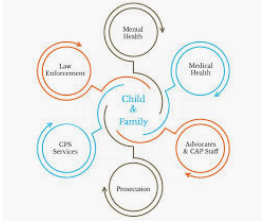
Many different disciplines are looking at the impact of trauma and trauma informed care. It is being implemented in many aspects of children’s daily life and will hopefully encourage better outcomes for adult survivors of childhood complex trauma. These are just a few of the disciplines asking the questions and making an impact, and certainly not a comprehensive list of people looking at trauma. What we do know is that all these professionals and viewpoints are necessary to develop the full picture of trauma and resiliency. It really does take a village to raise a child.